
World Cup 2026 will not be a normal football betting period for sportsbook operators. It will be a prolonged global demand cycle, with 48 national teams, 104 matches, multiple host markets across North America, and a final scheduled for July 19, 2026, at New York New Jersey Stadium.
For operators, that scale changes the preparation model. A World Cup 2026 sportsbook needs more than football markets, bonuses, and match banners. It needs resilient infrastructure, reliable live betting infrastructure, disciplined sportsbook risk management, flexible sportsbook payments, a realistic acquisition plan, and operational controls that can hold under pressure.
Why World Cup 2026 Requires More Than a Standard Sportsbook Setup
World Cup betting demand is different from a normal football weekend. Regular league traffic is usually predictable: operators know the peak windows, player behavior patterns, main leagues, payment pressure, and trading exposure. A global tournament compresses attention into fewer moments and creates sharp spikes around team news, kickoff, goals, penalties, red cards, and knockout-stage drama.
A standard setup may work during ordinary matchdays but fail during a major football event because the pressure is simultaneous across several departments:
- Technology teams face traffic spikes, API load, mobile performance issues, and incident response pressure.
- Trading and risk teams manage fast-changing markets, liability concentration, live betting volatility, and automated alerts.
- Payment teams handle deposit spikes before kickoff and withdrawal pressure after high-profile matches.
- Compliance teams monitor KYC, AML, suspicious activity, and responsible gambling triggers.
- Marketing teams compete for paid traffic, affiliate visibility, organic search demand, and retention after the tournament.
This is why betting platform preparation should start as an operational program, not a last-minute marketing campaign. Operators planning an online betting platform launch before the tournament should treat World Cup readiness as part of the launch roadmap, not as an add-on after the platform goes live.
World Cup 2026 Sportsbook Preparation Areas
| Area | Main Risk | What Operators Should Prepare | Business Impact |
|---|---|---|---|
| Infrastructure | Downtime or degraded performance during match peaks | Load testing, autoscaling, CDN tuning, monitoring, incident playbooks | Protects revenue windows and user trust |
| Live Betting | Latency, incorrect pricing, delayed suspension | Reliable odds feeds, trading rules, market suspension logic, exposure alerts | Reduces pricing errors and liability concentration |
| Payments | Failed deposits, delayed withdrawals, liquidity pressure | Payment routing, wallet liquidity planning, fraud checks, payout workflows | Improves conversion and reduces support pressure |
| Risk | Bonus abuse, multi-accounting, sharp exposure | Limits, segmentation, fraud signals, trading controls | Protects margin and operational stability |
| Compliance | KYC/AML gaps and weak player protection | Verification workflows, monitoring rules, responsible gambling controls | Reduces regulatory and reputational risk |
| Acquisition | Expensive traffic with poor retention | SEO planning, affiliate control, paid campaign discipline, CRM flows | Turns tournament demand into longer-term users |

Infrastructure Readiness: Servers, CDN, Uptime and Load Testing
Sportsbook infrastructure is one of the first pressure points during a tournament. Users do not experience infrastructure as servers, databases, and APIs. They experience it as page speed, bet slip response time, login reliability, payment confirmation, live odds movement, and whether the platform stays available during the biggest moments.
A serious sportsbook infrastructure plan should be built around traffic behavior, not average traffic. The problem is rarely the normal baseline. The problem is what happens 30 minutes before kickoff, during lineup announcements, after a goal, during penalties, and after major results.
Traffic Peaks and Match-Day Load Patterns
Tournament traffic is uneven. Operators may see quiet periods followed by sudden surges when a major national team plays or a knockout-stage match goes into extra time. These spikes can affect:
- Homepage and event page loading
- Login and registration flows
- Bet slip validation
- Live odds refresh
- Bonus claim pages
- Deposit pages
- Withdrawal requests
- Customer support access
Load testing should simulate real user behavior, not just generic page visits. A useful test should include browsing markets, adding selections to the bet slip, changing stake size, accepting odds movement, logging in, depositing, withdrawing, and switching between live and pre-match markets.
Operators should also test mobile-heavy scenarios. During major matches, many users are not sitting at a desktop. They are betting from mobile devices, often on unstable connections, while watching the match or following live updates.
CDN, Caching and Geo-Performance
CDN performance matters because World Cup traffic is geographically distributed. A sportsbook may serve users from multiple regions, devices, and network conditions at the same time. Poor geo-performance can create uneven user experience: one region may load quickly while another sees slow pages, failed assets, or delayed bet slip actions.
Operators should review:
- CDN coverage in priority markets
- Cache rules for static assets
- Dynamic content handling
- Mobile page weight
- Image and script optimization
- DNS resilience
- API endpoint routing
The business impact is simple: slow performance reduces conversion. During a high-traffic betting period, even small delays can increase abandoned registrations, failed deposits, and incomplete bet placements.
Infrastructure upgrades also affect budget planning. Operators reviewing online betting website cost should account for tournament-specific capacity, monitoring, CDN configuration, payment integrations, security tooling, and operational support instead of focusing only on the initial platform build.
Uptime Monitoring and Incident Response
Uptime monitoring should not only confirm whether the site is online. It should detect degraded performance before users flood support channels. Operators need monitoring across:
- Front-end availability
- API response time
- Odds feed connectivity
- Payment provider response
- Database performance
- Authentication services
- Bet placement success rate
- Error rates by region and device
Incident response must be prepared before tournament traffic arrives. Teams should know who makes decisions, who communicates internally, who contacts providers, who updates customer support, and which features can be temporarily limited if needed.
A practical incident response plan should define severity levels. A slow promotional landing page is not the same as failed bet placement during a knockout match. Clear priority rules reduce confusion when several systems are under pressure at once.

Live Betting Infrastructure: Odds Feed, Latency and Trading Exposure
Live betting infrastructure is one of the highest-risk areas for a World Cup 2026 sportsbook. Pre-match betting gives operators more time to price, review markets, and adjust exposure. Live betting compresses decision-making into seconds.
During major matches, latency becomes both a technical issue and a financial issue. If odds updates, bet acceptance, or market suspension are delayed, operators may accept bets at prices that no longer reflect the match situation.
Why Latency Becomes a Business Risk During Major Matches
Latency is not only about user experience. In live betting, latency affects pricing accuracy, exposure, and dispute risk. A delay between an on-field event and the sportsbook response can create serious problems when:
- A goal is scored but markets remain open too long.
- A red card changes match probability before odds are adjusted.
- A penalty is awarded and suspension rules are too slow.
- Users exploit faster external information sources.
- Bet acceptance rules are inconsistent across devices or regions.
The operator should define acceptable latency thresholds for odds updates, bet placement, bet settlement, and market suspension. These thresholds should be tested under load, not only in normal conditions.
The phrase live betting during World Cup 2026 should not be treated as a content topic only. It represents a real operational challenge: fast markets, high user emotion, heavy traffic, and sharp risk concentration during a short event window.
Odds Feed Reliability and Market Suspension Rules
Odds feed reliability should be tested before the tournament. Operators need to understand provider redundancy, failover behavior, event coverage, data delay policies, settlement rules, and support escalation.
Market suspension rules are especially important during high-intensity matches. Operators should review rules for:
- Goals
- VAR checks
- Penalties
- Red cards
- Serious injuries
- Extra time
- Penalty shootouts
- Match interruption
- Abandoned or postponed matches
Suspension logic should be clear to trading, support, and product teams. If users see markets open at the wrong moment or bets rejected without clear handling, support pressure increases and trust drops.
Trading Limits, Exposure Control and Automated Alerts
Sportsbook risk management during the World Cup should include both pre-match and in-play exposure controls. Popular national teams, emotional betting patterns, and heavily promoted offers can create liability concentration in specific outcomes.
Operators should define:
- Maximum liability by match
- Maximum liability by market
- Stake limits by user segment
- Limits for newly registered accounts
- Bonus-funded betting restrictions
- Alert thresholds for unusual betting patterns
- Manual review rules for high-risk activity
Automated alerts help risk teams react quickly, but they should not replace human oversight. During a tournament, the strongest approach is usually a combination of system rules, experienced trading review, fraud signals, and clear escalation paths.
If AI-powered betting technology is used, it should support decision-making through pattern detection, anomaly alerts, segmentation, and operational prioritization. It should not be presented as a magic solution that removes risk.

Payment Readiness: Deposits, Withdrawals and Wallet Liquidity
Sportsbook payments can become a bottleneck during major tournaments. Users may tolerate a slower content page, but they rarely tolerate failed deposits before kickoff or delayed withdrawals after a winning match.
Payment readiness should include provider performance, routing logic, fraud checks, liquidity planning, reconciliation, refund handling, and support scripts. During World Cup betting demand, payment operations become part of the customer experience.
Deposit Spikes Before Kickoff
Deposit traffic often increases before major matches, especially when users return after a quiet period or respond to promotions. Operators should test whether deposit methods can handle peak demand across cards, local payment methods, e-wallets, bank transfer options, crypto rails where legally supported, and alternative methods relevant to their market.
A deposit failure before kickoff can create immediate revenue loss. It can also push users to competitors. Operators should prepare:
- Backup payment routes
- Clear error messaging
- Provider-level monitoring
- Deposit confirmation tracking
- Support escalation for failed transactions
- Fraud screening that does not block legitimate users unnecessarily
Payment approval rates should be monitored by provider, country, method, device, and time window. A single underperforming route can create a major conversion issue during a tournament.
Withdrawal Pressure After High-Profile Matches
Withdrawal pressure often rises after high-profile matches, upset results, and knockout rounds. If a sportsbook is not prepared, finance and support teams can face delays, user complaints, and reputational damage.
Operators should review withdrawal limits, approval workflows, manual review capacity, provider settlement timing, wallet balances, and fraud checks. A useful plan for cash flow management for betting businesses should consider both incoming deposits and outgoing payout pressure, because tournament liquidity is not only about revenue collection.
Payment Routing, Fraud Checks and Liquidity Planning
Payment routing should be flexible enough to respond when a provider is slow, unavailable, or underperforming. Operators should not depend on one payment path for critical tournament periods.
Fraud checks also need balance. Weak checks expose the operator to chargebacks, stolen payment methods, bonus abuse, and money movement risk. Overly aggressive checks can block legitimate users and damage conversion.
A practical payment readiness plan should include:
- Provider redundancy
- Transaction monitoring
- Chargeback review
- Withdrawal queue rules
- Manual review staffing
- Liquidity buffers
- Reconciliation routines
- VIP payout handling
- Clear customer communication templates
Payment operations should be included in tournament war rooms. They are not a back-office function during a World Cup. They are a live operational control point.

Risk Management Before and During the Tournament
Risk management is where tournament preparation becomes disciplined. World Cup traffic can attract valuable users, but it can also attract fraud rings, bonus hunters, multi-accounting attempts, payment abuse, account takeovers, and suspicious betting behavior.
Operators should not wait for fraud to appear before adjusting controls. Tournament campaigns, acquisition incentives, and bonus offers should be reviewed through a risk lens before launch.
Bonus Abuse and Multi-Account Risk
Bonus abuse becomes more likely when operators compete aggressively for new users. A poorly designed bonus can attract low-quality traffic and create avoidable exposure.
Operators should review:
- Account creation velocity
- Device and IP signals
- Duplicate identity indicators
- Payment method reuse
- Bonus claim patterns
- Linked account behavior
- Unusual betting sequences
- Withdrawal attempts after bonus conversion
The goal is not to block legitimate customers. The goal is to prevent structured abuse while preserving a smooth onboarding experience for real users.
One of the most common sportsbook launch mistakes is relying on aggressive promotions without matching fraud controls, trading limits, and payment review capacity. During World Cup 2026, that mistake can scale quickly because traffic volume is higher and user behavior is more compressed.
KYC, AML and Suspicious Activity Monitoring
KYC and AML processes should be reviewed before tournament campaigns begin. If verification queues become overloaded during peak traffic, operators may face delays, frustrated users, and compliance pressure at the same time.
A balanced KYC and AML approach should include:
- Clear verification triggers
- Risk-based review rules
- Document verification capacity
- Source-of-funds escalation where required
- Suspicious transaction monitoring
- Payment method consistency checks
- Record keeping
- Support scripts for verification delays
Compliance teams should coordinate with marketing before major campaigns. If acquisition volume grows faster than verification capacity, the platform may create its own operational bottleneck.
Responsible Gambling Controls During High-Intensity Events
Major football tournaments can create emotional betting behavior. Operators should prepare responsible gambling controls that identify risk signals and support player protection.
Controls may include deposit limit tools, timeout options, self-exclusion workflows, reality checks, intervention rules, safer gambling messaging, and escalation procedures for concerning behavior.
From a business perspective, responsible gambling is not separate from platform quality. Weak player protection can create regulatory risk, reputational damage, and long-term trust issues. Strong controls help operators manage the tournament responsibly while maintaining a healthier platform environment.
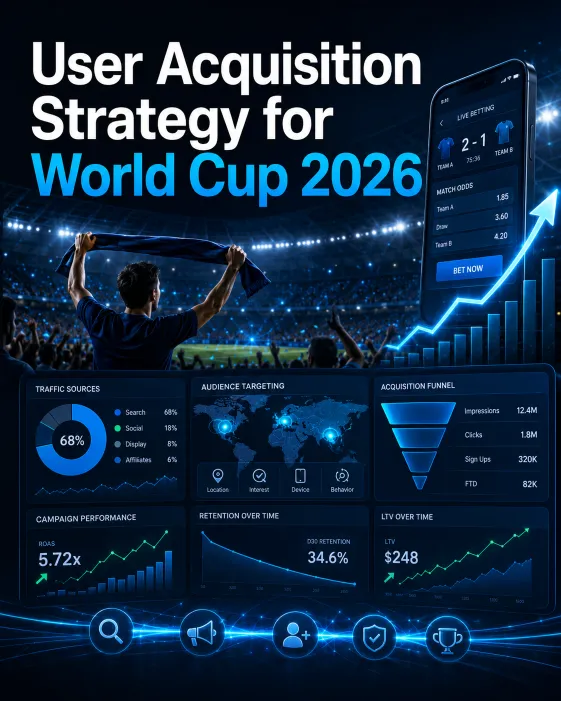
User Acquisition Strategy for World Cup 2026
User acquisition for betting operators should start before search demand peaks. If a sportsbook waits until the opening match, paid media costs may already be high, affiliate inventory may be competitive, and organic search visibility may be difficult to win.
A World Cup acquisition plan should combine search, paid campaigns, affiliate partnerships, CRM, community channels, and retention strategy. The objective is not only to acquire users during the tournament. The objective is to acquire users who can remain valuable after the final.
SEO, Content Planning and Search Demand
Search demand around World Cup 2026 will include fixtures, teams, groups, odds, predictions, stadiums, qualification paths, squad updates, and live betting interest. Operators should plan content around business goals, user intent, jurisdictional restrictions, and responsible gambling standards.
A strong World Cup 2026 betting SEO plan for operators should avoid publishing generic match content without a clear purpose. Better planning connects informational pages, market pages, tournament guides, betting education, and localized content in a way that helps users find relevant information quickly.
Content should also support platform trust. Pages that explain payment methods, verification, responsible gambling tools, bonus terms, and withdrawal rules can reduce friction before users register or deposit.
Paid Campaigns, Affiliate Traffic and Community Channels
Paid campaigns can move quickly, but they also create risk if not controlled. Operators should define campaign budgets, channel rules, landing page readiness, bonus terms, tracking accuracy, and compliance review before traffic starts.
Affiliate traffic can be valuable during the tournament, but quality control matters. Operators should monitor affiliate claims, traffic sources, conversion quality, bonus abuse rates, and retention metrics. High sign-up volume is not always high business value.
Community channels can support acquisition when used responsibly. Football audiences often gather around national teams, local communities, creators, social platforms, and messaging groups. Operators should avoid aggressive gambling language and focus on clear, compliant, useful communication.
Retention Beyond the Tournament
Many operators focus on acquisition before a tournament and forget retention until traffic declines. That is a costly mistake. Retention should be planned before the first match.
Post-tournament retention can include:
- CRM journeys by user segment
- Personalized sports preferences
- Responsible bonus offers
- Football league transition campaigns
- Loyalty mechanics with clear terms
- Re-engagement after major fixtures
- Cross-sell only where legally and ethically appropriate
- Customer support follow-up for unresolved issues
The strongest operators do not treat World Cup users as one-time traffic. They use the tournament to identify user segments, learn preferences, improve product experience, and build longer-term engagement.
User Acquisition Channels for World Cup 2026
| Channel | Best Use During the Tournament | Risk | Operator Note |
|---|---|---|---|
| Organic search | Capturing fixture, team, odds, and guide-related demand | Late publishing may fail to gain visibility | Build content before peak demand and keep it updated |
| Paid search | High-intent acquisition around betting terms | Expensive clicks and strict compliance rules | Use clear landing pages and approved claims |
| Affiliates | Expanding reach in priority markets | Low-quality traffic or misleading promotion | Monitor traffic quality and bonus abuse indicators |
| CRM | Activating existing users before key matches | Over-messaging and user fatigue | Segment by behavior and respect responsible gambling controls |
| Social and community channels | Supporting awareness and engagement | Compliance and brand safety issues | Keep messaging responsible and avoid unrealistic claims |
Operational Checklist for Sportsbook Owners
A tournament readiness checklist helps operators move from broad planning to accountable execution. Each department should know what must be ready, who owns it, when it will be tested, and what happens if it fails.
Technical Checklist
- Run realistic load tests using match-day user journeys.
- Confirm autoscaling rules and infrastructure limits.
- Test CDN behavior in priority regions.
- Monitor API response time and bet placement success rate.
- Validate backup systems and failover processes.
- Prepare incident response roles and escalation paths.
- Review mobile performance under poor network conditions.
Payment Checklist
- Confirm provider capacity for deposit spikes.
- Set backup payment routes for priority markets.
- Prepare liquidity buffers for withdrawal pressure.
- Review withdrawal approval workflows.
- Monitor approval rates by provider and region.
- Prepare support scripts for failed or delayed transactions.
- Strengthen fraud review without blocking legitimate users unnecessarily.
Risk and Compliance Checklist
- Review exposure limits by market, match, and user segment.
- Prepare live betting suspension rules.
- Monitor bonus abuse and multi-account signals.
- Confirm KYC capacity during registration spikes.
- Review AML monitoring rules.
- Test responsible gambling tools and escalation procedures.
- Align marketing campaigns with compliance requirements.
Marketing Checklist
- Prepare tournament landing pages before demand peaks.
- Build content around real user intent.
- Review affiliate messaging and traffic quality controls.
- Define paid campaign budgets and compliance approval flows.
- Segment CRM campaigns by user behavior.
- Plan retention journeys before the tournament starts.
- Measure post-tournament value, not only sign-up volume.
Pre-Tournament Readiness Checklist
| Department | Key Preparation Task | Priority | Recommended Timing |
|---|---|---|---|
| Technology | Full load testing with realistic betting journeys | Critical | 4–6 months before tournament |
| Trading | Exposure limits and live market suspension review | Critical | 3–5 months before tournament |
| Payments | Provider routing, liquidity planning, payout workflow review | Critical | 3–5 months before tournament |
| Compliance | KYC, AML, suspicious activity, and responsible gambling review | Critical | 3–4 months before tournament |
| Marketing | Search, paid, affiliate, and CRM campaign preparation | High | 4–6 months before tournament |
| Support | Match-day scripts, escalation rules, and staffing model | High | 2–3 months before tournament |
| Product | Mobile UX, bet slip performance, bonus visibility, account flows | High | 2–4 months before tournament |
| Finance | Reconciliation, settlement timing, wallet liquidity, reporting | High | 2–3 months before tournament |
How NitroPlay Group Helps Operators Prepare for World Cup 2026
NitroPlay Group supports sportsbook owners and iGaming businesses that need to prepare for high-traffic sports events with a practical, operator-focused approach. The preparation process is not limited to front-end design or campaign planning. It includes platform readiness, sportsbook infrastructure, risk workflows, payment planning, user acquisition support, and operational scaling.
For operators preparing a World Cup 2026 sportsbook, NitroPlay Group can help connect technical, commercial, and operational priorities into one realistic roadmap. That means reviewing whether the platform can handle tournament traffic, whether payment flows are ready for deposit and withdrawal pressure, whether risk controls are suitable for live betting, and whether acquisition campaigns are supported by a retention plan.
The value is not in promising guaranteed results. The value is in reducing avoidable mistakes, improving readiness, and helping decision-makers understand what must be prepared before traffic arrives.
NitroPlay Group is best positioned as a B2B partner for operators that want to build, launch, improve, or scale a sportsbook with stronger operational discipline. During a major tournament, that discipline can be the difference between short-term traffic and a platform that can handle pressure professionally.
Final Takeaway
Preparing a sportsbook for World Cup 2026 is a business-wide operation. Infrastructure, live betting, payments, risk, compliance, acquisition, and retention must work together before tournament demand arrives.
The strongest operators will not treat the World Cup as a simple promotional window. They will test their systems, review their exposure, prepare payment liquidity, strengthen fraud controls, plan responsible acquisition, and build retention paths beyond the final.
A successful betting platform preparation plan should answer one question clearly: if traffic, deposits, live betting activity, support requests, and fraud signals all rise at the same time, can the sportsbook still operate with speed, control, and trust?
For operators that cannot answer that confidently yet, now is the time to prepare.
Frequently Asked Questions
When should a sportsbook start preparing for World Cup 2026?
A sportsbook should begin serious preparation several months before the tournament. Infrastructure testing, payment routing, risk controls, compliance workflows, affiliate agreements, content planning, and retention campaigns all need time. Waiting until match week increases the chance of technical issues, rushed campaigns, poor fraud control, and weak user experience.
What is the biggest infrastructure risk during the World Cup?
The biggest infrastructure risk is not only total downtime. Degraded performance can be just as damaging. Slow bet placement, delayed odds updates, failed deposits, login issues, and poor mobile performance can all reduce conversion and damage trust during peak match windows.
Why are payments critical during major football tournaments?
Payments are critical because deposits often rise before kickoff and withdrawals can increase after high-profile matches. If payment routes fail or payouts are delayed, users may lose confidence quickly. Operators need provider redundancy, liquidity planning, fraud checks, reconciliation workflows, and clear communication.
How can operators reduce live betting risk?
Operators can reduce live betting risk by improving odds feed reliability, defining market suspension rules, setting exposure limits, monitoring latency, using automated alerts, and ensuring experienced trading oversight. Live betting risk cannot be removed completely, but it can be controlled with better preparation.
How can sportsbook owners turn World Cup traffic into long-term users?
Sportsbook owners can improve long-term value by planning retention before the tournament starts. That includes CRM segmentation, clear onboarding, responsible offers, strong payment experience, relevant post-tournament campaigns, and product journeys that move users from World Cup interest into regular football engagement.